
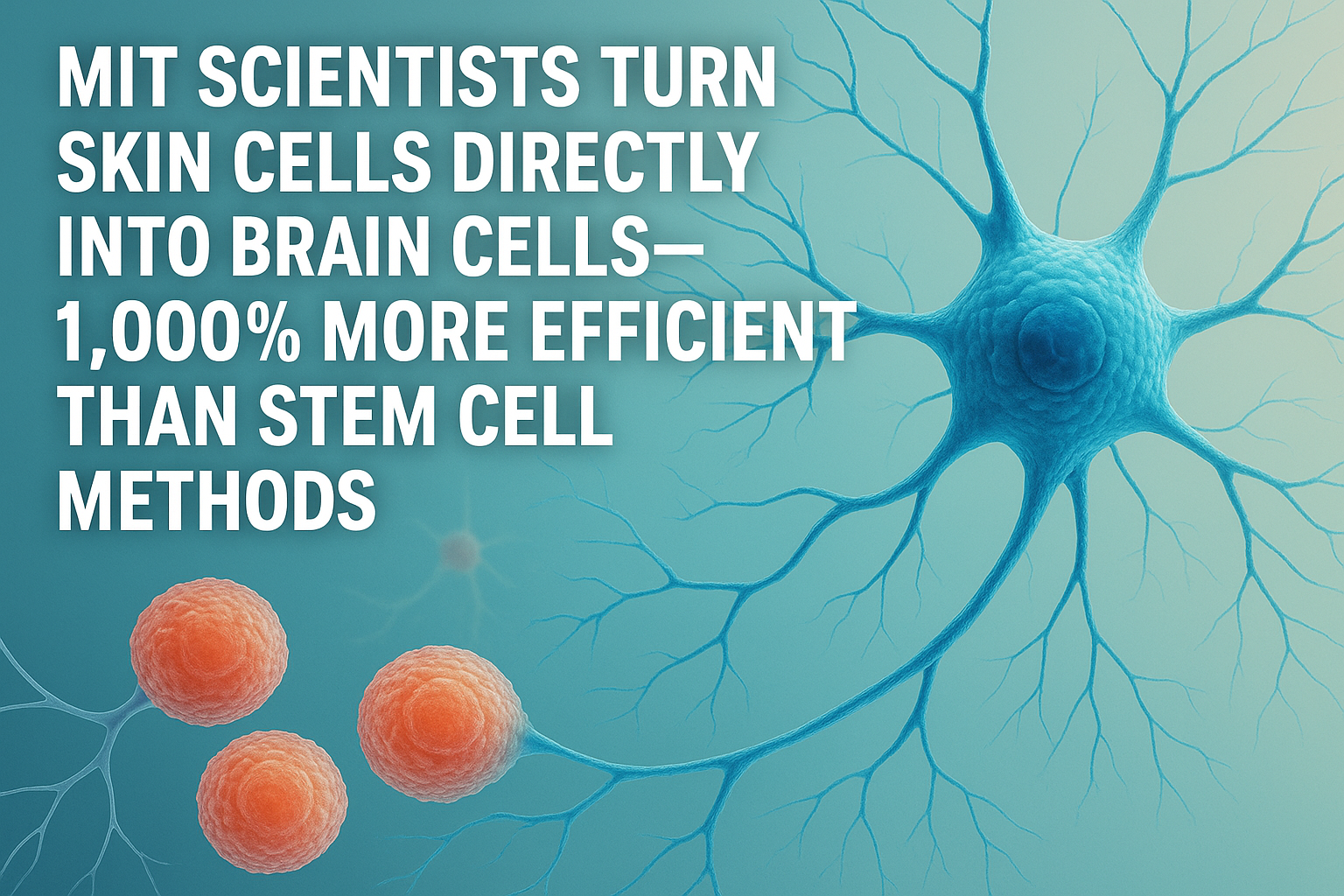
In a groundbreaking leap for regenerative medicine, scientists at MIT have developed a direct conversion process to transform ordinary skin cells into fully functional brain cells—bypassing the inefficient stem cell stage and achieving an efficiency boost of over 1,000%.
The advance could open the door to new therapies for neurodegenerative diseases like ALS, Parkinson’s, and spinal cord injuries, where replacing lost motor neurons has long been a medical holy grail.
🔬 The Breakthrough
The research team, led by Li-Huei Tsai and colleagues at MIT’s Picower Institute for Learning and Memory, identified a three-transcription-factor cocktail—NGN2, ISL1, and LHX3—that can reprogram human skin fibroblasts directly into motor neurons. These are the nerve cells responsible for controlling muscle movement and are often the first to deteriorate in ALS and other conditions.
Using a viral vector to deliver these genetic instructions, the scientists first encouraged the skin cells to proliferate—a step that dramatically improved their receptiveness to transformation. Once primed, the cells converted into motor neurons with unprecedented efficiency: one skin cell could yield 10 or more neurons, compared to previous direct-conversion success rates below 0.1% (news.mit.edu, cell.com).
🧪 Why Skip Stem Cells?
Traditional methods for generating patient-specific neurons involve first reprogramming cells into induced pluripotent stem cells (iPSCs) before coaxing them into neurons. This two-step process is slow, costly, and prone to developmental variability.
By cutting out the middleman—the iPSC stage—MIT’s approach reduces the time to generate neurons from months to just days, lowers the risk of unwanted cell types forming, and preserves patient-specific genetic signatures useful for personalized medicine.
⚡ Proof It Works
In lab tests on mice:
- The converted cells looked and behaved like authentic motor neurons, with long axons and dendrites.
- They fired electrical impulses and formed functional synapses.
- When transplanted into mouse brains and spinal cords, they integrated into existing neural circuits without abnormal growth.
These results strongly suggest that the neurons could work as replacements for damaged or lost brain cells in human patients.
🧠 Potential Applications
If confirmed in human trials, this technology could transform treatment strategies for:
- ALS & Motor Neuron Disease – Replacing degenerating neurons to restore muscle control.
- Spinal Cord Injuries – Repairing severed communication between brain and muscles.
- Parkinson’s & Other Neurodegenerative Disorders – Custom-grown neurons for cell replacement therapy.
- Drug Testing – Patient-derived neurons for personalized screening of therapies without invasive biopsies.
⚠️ Challenges Ahead
While promising, hurdles remain before this technique reaches the clinic:
- Safety – Viral vectors and transcription factors must be carefully controlled to avoid tumor risk.
- Scalability – Large quantities of neurons will be needed for human therapy.
- Longevity & Functionality – Transplanted neurons must survive long-term and integrate seamlessly into complex human neural networks.
The team is already exploring non-viral delivery systems and in vivo reprogramming, where cells are converted directly inside the body—potentially eliminating the need for cell transplants altogether.
🚀 The Bigger Picture
This work reflects a growing trend in neuroscience: direct lineage reprogramming. Instead of reverting cells to a primitive stem state, scientists are learning to jump them sideways into other functional cell types—fast, clean, and patient-specific.
As lead researcher Li-Huei Tsai noted:
“We’re not just making neurons faster—we’re making the exact neurons a patient needs, from their own cells.”
With further refinement, this technique could one day mean that regenerating brain cells from a patient’s own skin becomes as routine as a blood draw—an innovation that could redefine what’s possible in brain repair.