
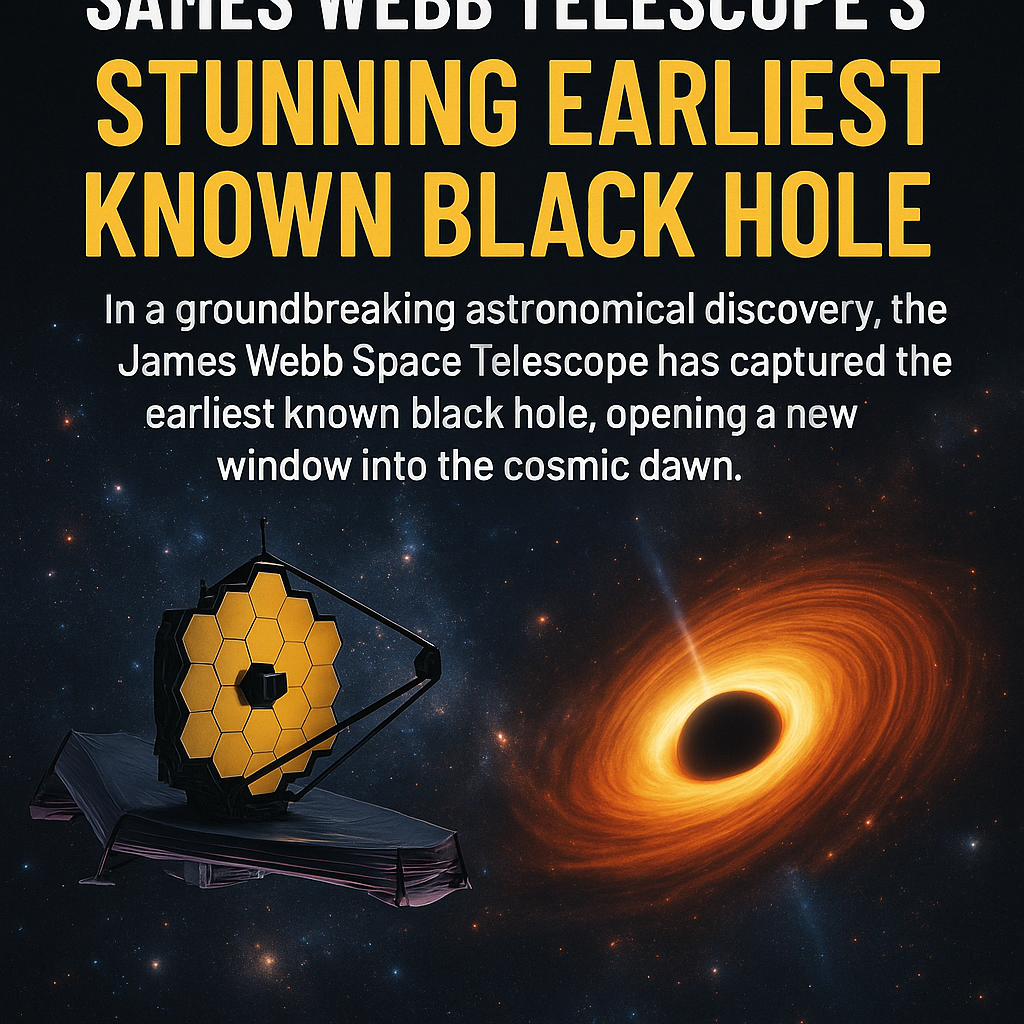
In a groundbreaking astronomical discovery, the James Webb Space Telescope (JWST) has captured the earliest known black hole, opening a new window into the cosmic dawn. This extraordinary find offers scientists an unprecedented glimpse into the infancy of our universe, shedding light on how black holes formed shortly after the Big Bang.
James Webb Telescope’s Stunning Discovery
The James Webb Telescope spots stunning earliest known black hole that existed over 13 billion years ago, during an era when the universe was just a few hundred million years old. This black hole, detected through its luminous footprint on surrounding matter, is a critical piece in understanding how supermassive black holes grew so rapidly in the young cosmos.
JWST’s powerful infrared capabilities have made this detection possible by peering through cosmic dust and gas that traditionally obscured such ancient objects from previous telescopes. Unlike its predecessor, the Hubble Space Telescope, JWST can observe the universe’s early epochs with remarkable clarity and sensitivity.
What Makes This Black Hole So Important?
Black holes, especially the supermassive variety, have always posed a mystery regarding their early formation. The discovery made by the James Webb Telescope challenges existing models that predicted black holes took much longer to form and grow. Finding a black hole this ancient indicates that black holes might have formed much faster and been more common in the universe’s early stages than previously thought.
Scientists believe this black hole was born from the collapse of the very first generation of stars, sometimes called Population III stars. These stars were massive, short-lived, and composed almost entirely of hydrogen and helium. When they ended their lives, the resulting black holes could immediately start feeding and growing quickly by devouring nearby matter.
How the James Webb Telescope Captured the Black Hole
JWST uses its suite of near and mid-infrared instruments to identify black holes by detecting the intense radiation emitted as matter swirls around their event horizons. In this case, the telescope observed a surprisingly bright source in the distant universe whose characteristics couldn’t be explained by stars or galaxies alone.
By analyzing the light spectrum, astronomers confirmed the presence of a black hole despite the vast distances and cosmic age. This ability to spot objects so far back in time will revolutionize our understanding of early galaxy formation and the role black holes played in shaping the cosmos.
What’s Next for Black Hole Research?
With the James Webb Space Telescope’s ongoing mission, more discoveries like this earliest known black hole are expected. Each new detection helps astronomers piece together the puzzle of how the universe evolved from a hot, dense state into the vast galaxy-filled expanse we see today.
Researchers are hopeful that JWST’s data will enhance black hole research, shedding light on their growth rates, feeding mechanisms, and eventual impact on galaxy development. This could also influence theories about dark matter and the large-scale structure of the universe.
—
The James Webb Telescope’s spotting of the earliest known black hole is a stunning milestone in modern astronomy. It not only pushes the boundaries of what humanity can observe but also deepens our understanding of cosmic beginnings. As JWST continues its quest, we may soon uncover even more secrets from the universe’s earliest moments—changing the way we think about black holes and the cosmos forever.