
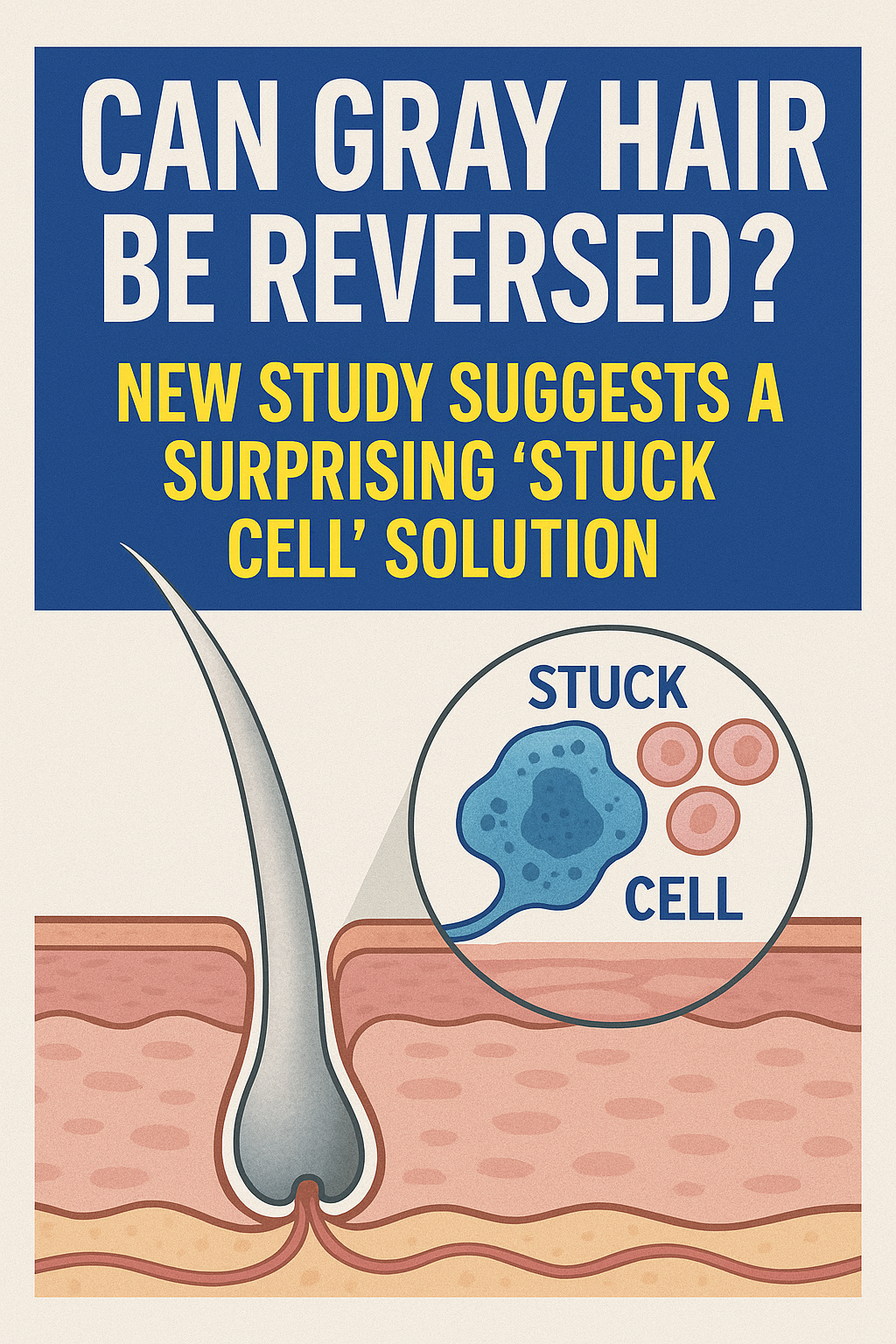
Here’s a bit of hope for anyone dismayed by the growing patch of silver in the mirror: scientists may have uncovered a way to reverse gray hair—and it doesn’t involve dye. A groundbreaking study from researchers at NYU Grossman School of Medicine suggests that hair graying may not be as permanent as we once thought.
The culprit? Tiny pigment stem cells that get… stuck.
🧬 The Science Behind the Color Shift
The study, published in Nature, focused on melanocyte stem cells (McSCs)—the precursors to the cells that produce melanin, the pigment responsible for hair color.
In youthful hair, these McSCs migrate freely between different compartments of the hair follicle as it cycles through growth phases. This mobility allows them to remain versatile and capable of becoming pigment-producing cells.
But as we age, researchers found, many of these McSCs become trapped in an area called the follicle bulge—a kind of cellular dead-end. Once they’re stuck, they can no longer receive the molecular cues (like WNT signaling proteins) needed to transform into melanin-makers.
The result? Hair that grows in without color.
🐁 Mice With Gray Hair—and a Path to Reversal
To prove their theory, researchers tracked McSCs in live mice. They discovered that follicles with immobile stem cells were more likely to lose pigment. Conversely, those where McSCs kept moving maintained their hair color.
This wasn’t just a theoretical shift—mice with the ability to keep their stem cells circulating were less likely to go gray.
💡 What This Could Mean for You
The findings suggest that gray hair isn’t necessarily a point of no return. If scientists can develop treatments that either free these “stuck” stem cells or prevent them from becoming immobile in the first place, they may be able to restore pigment to graying strands—or delay the process entirely.
Such therapies could come in the form of topical treatments, genetic tweaks, or future stem-cell-based interventions.
Dr. Qi Sun, one of the lead researchers, explained it this way:
“Our study adds to our basic understanding of how melanocyte stem cells work to color hair, and lays the groundwork for future treatments to reverse or prevent gray hair.”
🧠 More Than Vanity
While gray hair is often seen as just a cosmetic concern, this research has implications beyond aesthetics. Stem cell aging and cellular mobility are core areas of study in age-related diseases and tissue regeneration.
If similar “mobility traps” affect other types of stem cells, the implications could extend to conditions like muscle loss, skin aging, and even neurodegeneration.
📌 The Takeaway
- Gray hair might not be forever.
- Pigment loss may come from stem cells getting stuck—not disappearing.
- Keeping stem cells moving could be the key to youthful hair—and maybe more.
So, the next time you find a silver strand, don’t panic. The future might bring science-backed solutions to bring your natural color back—no salon required.