
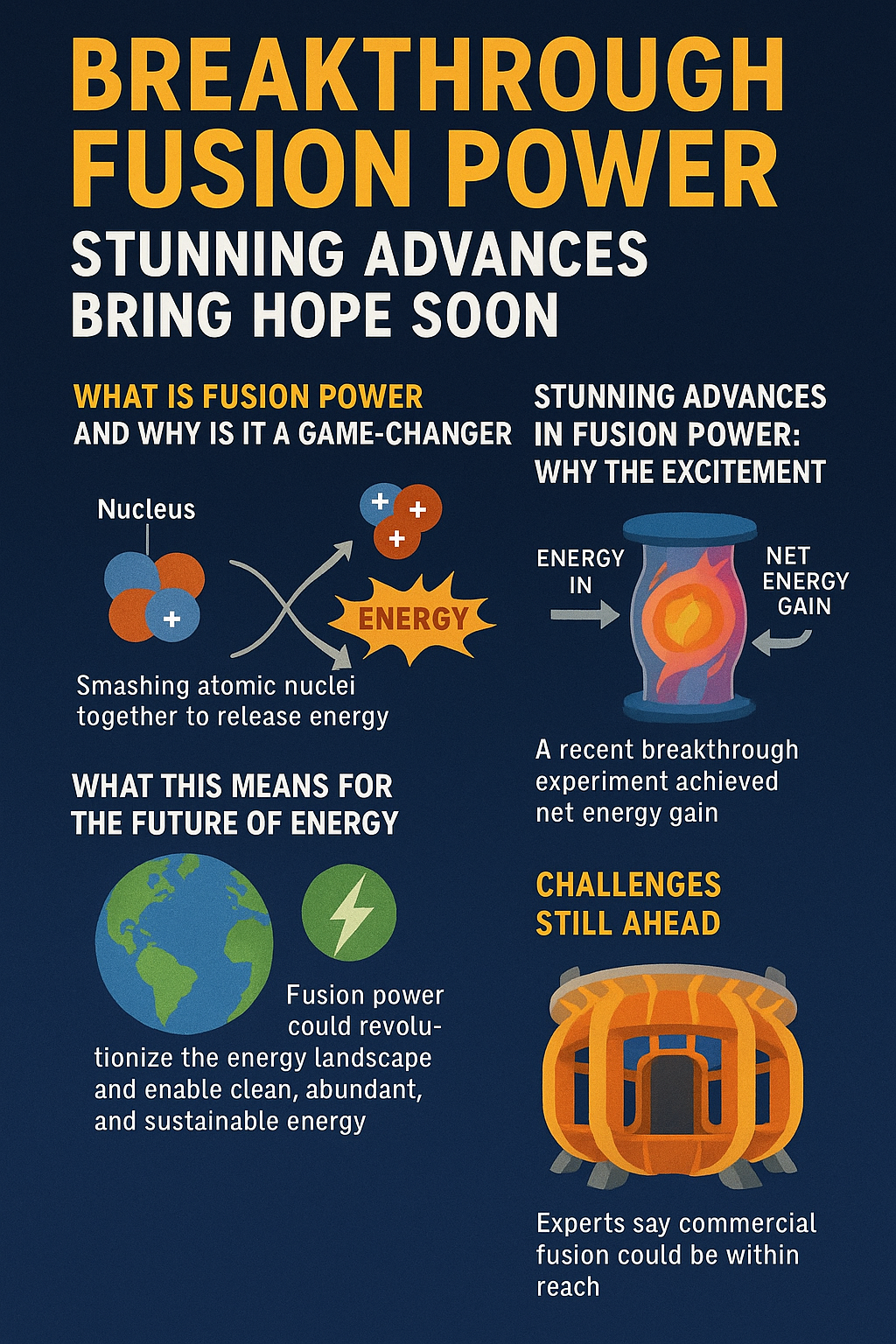
Breakthrough fusion power has once again captured the world’s attention after a remarkable surge in scientific progress. This renewable energy source, often dubbed the “holy grail” of clean energy, promises an almost limitless supply of power without the damaging emissions tied to fossil fuels. Recently, researchers have made significant strides that could bring fusion energy from a decades-long dream to a near-future reality.
What Is Fusion Power and Why Is It a Game-Changer?
Fusion power is the process that fuels the sun—smashing atomic nuclei together to release energy. Unlike fission, which splits atoms (and generates hazardous waste), fusion produces minimal radioactive waste and no carbon emissions. If harnessed successfully, it could provide a safe, sustainable, and virtually inexhaustible energy source to meet global demands.
Despite its promise, fusion energy has been notoriously difficult to control on Earth. The fuel needs to be heated to temperatures exceeding 100 million degrees Celsius—hotter than the core of the sun—and contained in a stable plasma long enough to extract energy efficiently. For decades, this challenge has kept fusion power locked in experimental labs.
Stunning Advances in Fusion Power: Why the Excitement?
The breakthrough fusion power developments came from a recent experiment at the National Ignition Facility (NIF) in California, where scientists achieved “ignition”—a key milestone where the fusion energy output surpassed the energy input. This achievement, announced in late 2022, shocked the scientific community as a major leap forward, suggesting that net energy gain from fusion could now be within reach.
Additionally, startups and international projects such as ITER (International Thermonuclear Experimental Reactor) and private companies like Commonwealth Fusion Systems are fast-tracking new reactor designs using innovative magnets and more efficient plasma confinement techniques. These innovations reduce costs and accelerate timelines for building the first commercial fusion reactors.
What This Means for the Future of Energy
With fusion power edging closer to practicality, the implications are huge. It could revolutionize the energy landscape, drastically cutting greenhouse gas emissions and reducing our reliance on fossil fuels. Grid-scale fusion plants could power cities continuously with clean energy, supporting a green economy and helping combat climate change.
Moreover, fusion fuel is abundant. Common isotopes like deuterium can be extracted from seawater, meaning we have practically unlimited raw materials. This plentiful supply contrasts sharply with limited fossil fuel reserves, making fusion a long-term solution for global energy security.
Challenges Still Ahead
Despite the optimism surrounding recent breakthroughs, significant engineering and economic hurdles remain. Building reliable, cost-effective fusion reactors that operate continuously is a complex challenge. Advanced materials, superconducting magnets, and efficient plasma control all require further refinement before fusion power can be deployed widely.
However, the renewed momentum, investment billions in funding, and international cooperation give experts confidence that commercial fusion power plants could be a reality within the next 10 to 20 years.
Conclusion: A Bright Energy Horizon with Breakthrough Fusion Power
Breakthrough fusion power is no longer a science fiction concept but an emerging technology with the power to reshape our global energy system. The stunning advances achieved in recent years offer genuine hope that clean, abundant, and sustainable energy will soon help unlock a brighter future for all.
As fusion research pushes forward, the dream of harnessing the power of the stars on Earth may finally come true—ushering in a new era of energy innovation and environmental stewardship.
—
Stay tuned with us for the latest updates on fusion power and revolutionary energy technologies shaping tomorrow’s world.